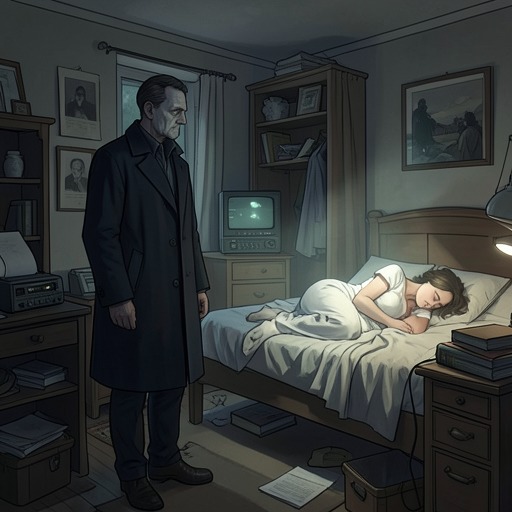
Henry’s failed attempt to intervene in Ingrid’s suicide
The Time Traveler's WifeHenry’s failed attempt to intervene in Ingrid Carmichel’s suicide is a scene of foreknowledge without control. On January 2, 1994, Henry arrives in Ingrid’s apartment from December 2006, injured and disoriented; he knows the date is the day she will kill herself, but neither that knowledge nor his effort to reach her can alter what happens. His attempt to offer care becomes a confrontation, and the encounter ends with Ingrid shooting herself while he is unable to stop her.
Arrival in a remembered past
The scene opens in Henry’s first-person account of a night crossing: pain seizes his legs, and before he can take a Vicodin he is falling onto a floor that belongs to another place and time. The familiar smells of bleach, sweat, and perfume begin to identify the apartment before the lights come on. Ingrid finds him crawling on the floor. The disorientation is physical as well as temporal: Henry is in pain, has arrived without warning, and must piece together where and when he is from the sensations around him.
Once Ingrid offers him an assortment of pills, Henry chooses two Ultram and drinks water she fetches for him. She asks when he is coming from; he answers that it is December 2006 and asks for the date. Ingrid checks her watch and tells him it is January 2, 1994. The precise date turns an abrupt visit into a crisis. Henry recognizes that this is the day Ingrid will commit suicide, so a reunion that might otherwise have been bewildering or intimate is immediately shadowed by what he knows will follow.
Foreknowledge becomes an appeal
Henry does not tell Ingrid directly that she is going to die. Instead, while sweating and hesitating over what he can say without frightening her, he asks her to be nice to herself and begins to acknowledge that she is unhappy. His warning is necessarily indirect: he possesses knowledge about her future but has no straightforward way to present it that might persuade her to change course. The gap between what he knows and what he can tell her governs the scene.
Ingrid answers by asking whose fault her unhappiness is, then challenges Henry over how mean he was to her and why he treated her that way. Henry looks away before answering that he did not want to be mean. The question turns his attempt to help into an encounter with their shared history. Instead of receiving his concern as an uncomplicated offer of comfort, Ingrid presses him to account for the hurt between them. Their exchange leaves Henry facing both the coming suicide and the possibility that his own past conduct forms part of what must be addressed between them.
The gun and the failed intervention
Ingrid plays with her lighter and proposes the possibility that she is dead. When Henry recoils, she says that this possibility appeals to her and that it has given her an idea. She leaves the room, opens and shuts a drawer, then returns with a gun concealed behind her back. The action converts an allusive conversation about death into an immediate threat: Ingrid points the weapon at Henry, making him the person in danger as well as the person who knows what she will do.
Henry asks her to give him the gun. Ingrid refuses and tells him to come and get it. Slowed by the painkiller, Henry climbs off the couch and crawls across the floor, trailing the afghan, as she backs away with the gun trained on him. The scene makes the limits of his intervention visible in his body: injured and impaired, he cannot close the distance quickly, and Ingrid controls both the weapon and the space between them.
When Ingrid asks whether he is sure, she moves the gun to her chest and asks whether the head or the heart would be better. Henry says nothing that changes her course. He could touch her or grab her, but Ingrid kicks him in the chest, knocking him backward, and spits in his face. Looking down at him, she asks whether he loved her. Henry says yes; Ingrid calls him a liar and pulls the trigger. His knowledge has brought him to the scene, but the encounter ends without his being able to prevent her suicide.
Consequence and narrative significance
The episode’s structure places Henry’s 2006 arrival inside the past that he already knows, giving an ordinary question about the date an irreversible answer. That foreknowledge sharpens rather than resolves the conflict: Henry can identify what is about to happen, yet he cannot disclose it in a way that saves Ingrid or overcome her refusal when the gun appears. The reversal from his attempted plea to his physical helplessness turns time travel into exposure to a known outcome, not an opportunity to rewrite it.
The scene also makes their unresolved relationship inseparable from the crisis. Ingrid’s questions about blame and Henry’s meanness interrupt his effort to speak about her safety; her final question about love demands an answer at the very moment that his actions cannot persuade her to live. His affirmation does not settle their history or stop the trigger. The failed intervention therefore carries two forms of powerlessness at once: Henry cannot change the death he remembers, and he cannot make his expression of care undo the injury between them.